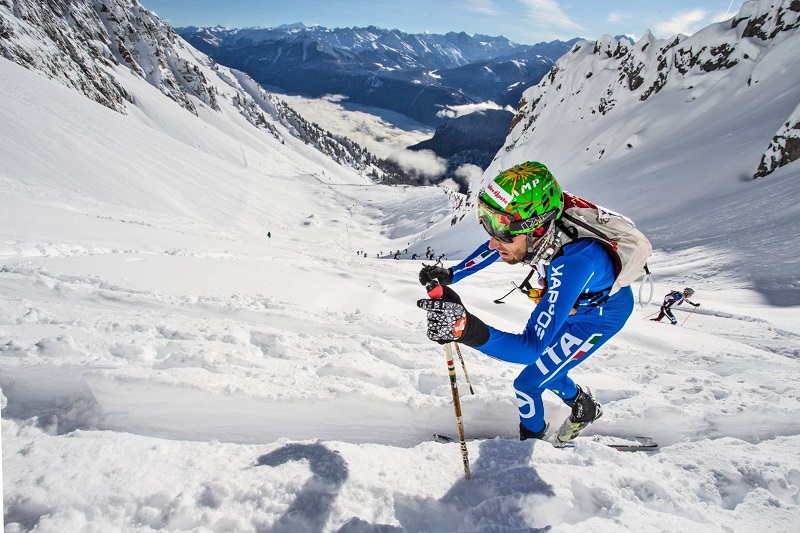
Mountain skiing, ski touring, spring skiing, and of course competitive ski mountaineering, all of which reflect different ways of practising the same discipline: ski mountaineering.
Mountain skiing is placed at the confluence of hiking for the discovery of the mountain, mountaineering for safety techniques, cross-country skiing for the pleasure of gesture to climb and ski inge and piste skiing for the downhill technique.
On the climb, the fasteners are mobile at the back and allow you to climb up slopes using an anti-recoil device placed under the skis: seal skins.
On the descent, the back of the shoes is switched in the fasteners (while in telemark we leave the rear mobile) to ski as in piste skiing.
Ski touring
This is the leisure side of the discipline. No stopwatch, just the pleasure of being in the mountains and traversing wide open spaces on your own. The route is not marked, the touring skier is autonomous and able to judge the conditions of the mountain to know how to adapt his route and turn back if it proves necessary.
The satisfaction of the effort on the climb is at least equal to the feast of descents in unascepted terrain.
Ski touring is above all the discovery of a mountain or a ski top on its feet: isn’t it the best way to go to the nature mountain in winter?
Ski mountaineering:
This is the « performance » side of the discipline. Ski mountaineering-skimo is the term used for practice in competition of course but also in adventure terrain, where mountaineering techniques are available to skiing (orientation, crampon corridor, glacier safety, technical passages etc…)
In competition, everyone finds performance at their own level. The gradients proposed by the organizers are very diverse. A good hiker will find new satisfactions in travelling routes that, if marked and secure for the race, always have a special aspect.
Mountain skiing is placed at the confluence of hiking for the discovery of the mountain, mountaineering for safety techniques, cross-country skiing for the pleasure of gesture to climb and ski inge and piste skiing for the downhill technique.
On the climb, the fasteners are mobile at the back and allow you to climb up slopes using an anti-recoil device placed under the skis: seal skins.
On the descent, the back of the shoes is switched in the fasteners (while in telemark we leave the rear mobile) to ski as in piste skiing.
Read more in SkiMo at telemark-pyrenees.com?
Ski mountaineering, an ethical and aesthetic sport!
Ski mountaineering (also known as ski touring) consists of travelling mountain or high mountain routes, in one or more climbs and descents, using skis equipped with a mobile attachment to the climb (a bit like cross-country skis) and blocked at the downhill (as in alpine skiing). For the climb, the mountaineer inghies anti-recoil under his skis. This is the ideal means of travel in snowy environments as long as there is a bit of relief (flat countries prefer Nordic skiing) because the skis are snowy and can allow the crossing of slopes sometimes very steep.
The descent is done by removing the sticky skins and is akin to an off-piste descent.
The playground is huge, it starts near the resorts and extends to the highest peaks on the planet. Always with respect for nature, the mountaineering skier leaves only the footprint of his tracks in the snow…
A burgeoning discipline
Physical activity of nature, the number of practitioners in France is estimated in a range between 55,000 and 85,000 practitioners, regular or occasional …
As the practice is free, these estimates are based on the statements of the federated practitioners and annual sales of equipment (fixations, DVA, seal skins, skis etc).
Reserved for mountaineers who were savvy until the late 1970s, the discipline gradually developed in the alpine and Pyrenean valleys. And beyond that, the major urban centres (Paris, Lyon, Strasbourg…) send their battalions of enthusiasts every weekend…
The decade 2000 was marked by the arrival of new audiences among the practitioners. Indeed, a population with a less « mountain » initial culture and for whom ski mountaineering is not necessarily in the winter continuity of mountaineering, has been seduced by this discipline. This exciting new audience has thus discovered a new facet of skiing, offering a softer approach and respectful of nature and the great outdoors, without a queue at the ski lifts…
A complete sport
Ski mountaineering is a complete sport that brings together in the same discipline:
– the qualities of the downhill skier,
– the qualities of the mountaineer as long as there are technical passages (crampons to the feet, sometimes passages with rope!),
– specific techniques: the « manips » that allow you to go from the mounted position to the downhill position and vice versa…
– qualities of strategist: know how to choose his route, manage his race, his companions;
– endurance qualities: the effort lasts several hours, some are longer than a marathon.
– and finally a certain adaptability and resistance to the natural elements: cold, wind, humidity, changing terrain…
Ski mountaineering is an ideal sport for nature lovers as it takes place in the most beautiful landscapes between land and sky…
Addicted skiing
You quickly become addicted to ski mountaineering! Several reasons for this:
– The drunkenness of the descent in a fabulous and untouched setting
– The pleasure of the effort at the climb where everyone goes at his own pace and at his level: hiking discovery, family, technical outings or extreme skiing…
– Friendship of rare moments, shared at the top among friends.
– A wide variety of itineraries: ski mountaineering is practiced wherever there is snow and a bit of slope!

 Ski Touring, Skimo, ski telemark, Ski alpine, Freeride Ski, Shop ski touring