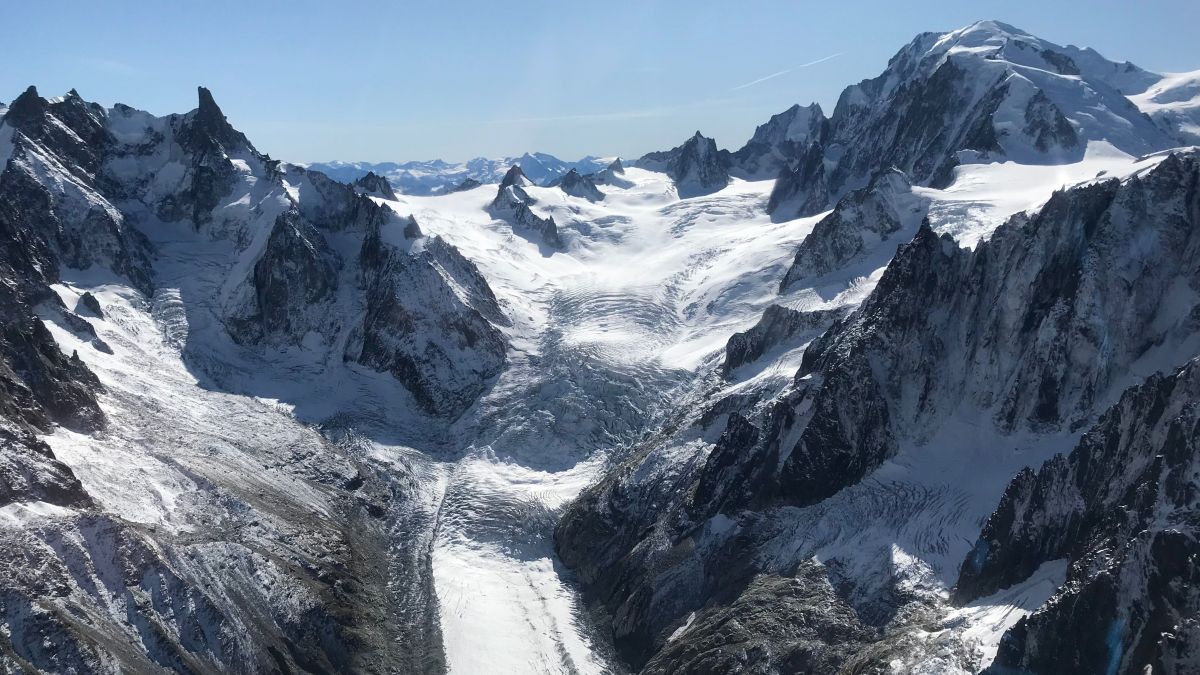
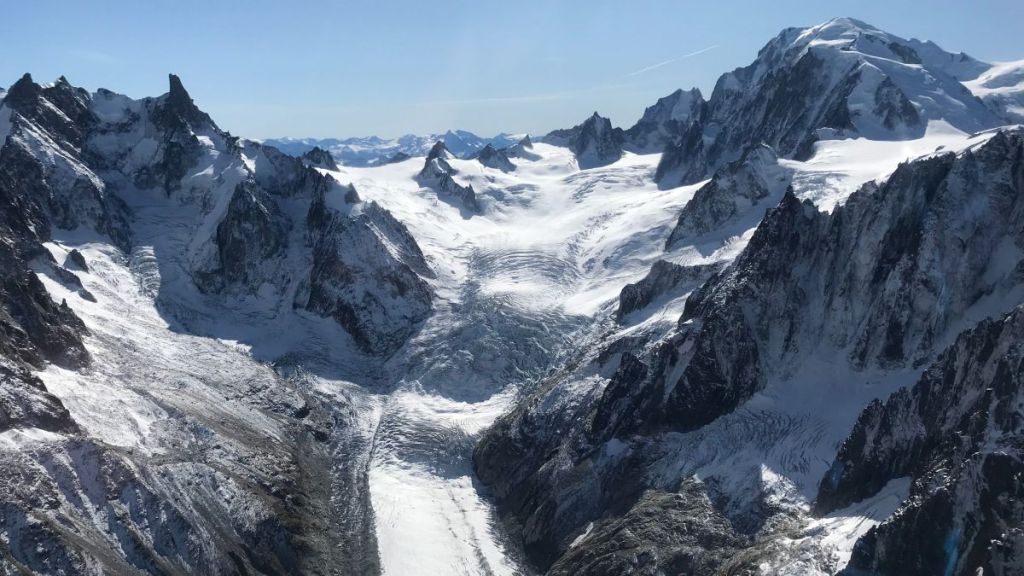
This four paragraphs explain why and how global warming melts the permafrost, crushes the mountains and accelerates the disappearance of glaciers.
It’s not difficult to imagine the link between global warming and its direct impact on our environment. Very often the image of the South and North Poles’ pack ice that shrinks from year to year comes to mind. However, in the French Alps global warming is directly impacting us. The heart of the mountains thaws, the temperature of the permafrost rises and the mountains crumble.
What is permafrost?
Permafrost can be likened to mountain cement. This layer has a permanently negative temperature that will allow the presence of ice in the fractures of the rock face, explains Ludovic Ravanel, a mountain guide and researcher at the CNRS. It allows stability »
A 2008 study estimates the area of permafrost in the French Alps at 1300 km2.
Global warming directly impacts this frozen layer, which melts and leads to soil deformations and subsidence of the land. « If the cement of the mountains is degraded, slopes can start to move end get destabilized » adds Ludovic Ravanel. This is what is happening today with the multiplication of heat waves » leading to the mountains breaking into pieces and threatening downstream the valleys and people.
Mountains crumble and glaciers melt
In the Mont Blanc Valley, temperatures have risen by 2°C in 80 years. The impact of global warming is visible by the naked eye: glaciers melt and retreat from year to year. And the forecasts are not reassuring.
Scientists expect an increase of 3°C by 2100, which would have devastating consequences for the two giants of the French Alps: the Argentière glacier and the Sea of Ice. « The Argentière glacier is in danger of disappearing completely by 2100 and the Sea of Ice will be reduced by 80% » explains glaciologist Christian Vincent.
As a result, the shrinking of the Argentière glacier could lead to the formation of « a gigantic lake with a size of about 12 million cubic meters » between 2040 and 2050, the glaciologist continues, which will represent « a potential danger » for the inhabitants which it is not yet possible to estimate accurately.
148 alpine infrastructure under threat
As a visible consequence of the melting glaciers is the multiple rock collapses in recent years. The collapse of a section of the Cosmic Ridge is a sad evidence of this. In August 2018, heat wave temperatures caused repeated rock collapses.
Located a few meters away, the Cosmic Refuge is a concrete example of the impact of permafrost melting on alpine infrastructure. Perched at an altitude of 3613 metres, the refuge dominates the Chamonix valley. It was built in 1990. But eight years later, a 600 m3 of rock collapsed affecting the building. So since 2009, a monitoring of instabilities with a laser scanning has been set up by scientists. The support of the hut has also been strengthened.
Another emblematic example is the Aiguille du Midi, is not spared by the degradation of the permafrost. The rock is now full of sensors that measure the temperature of the mountain deep into it and monitors the evolution of the permafrost. A dozen extensometers were installed to measure the deformations produced.
Pierre-Allain Duvillard, a geomorphologist, has carried out work on the stability of mountains’ infrastructures. From his detailed report results an alarming scenario: 148 mountain infrastructures are at risk amongst the 947 chair lifts, pylons, ski station bases and mountain huts built on frozen ground. Some 40 threatened structures have already been reinforced.
« Clearly this infrastructure could be dismantled and stations closed in the coming decades » says Antoine Chandellier, journalist at the Dauphiné Libéré. According to him the duration of the structures is threatened by the melting of permafrost.
Rethinking how to develop the mountain
Beyond the French borders, it is the entire alpine arc that must cope with the rising temperatures that weaken the mountains. « We’re going to have to be more vigilant than we were in the 1980s. The high mountain is changing and we have to adapt, » says Ludovic Ravanel, a researcher at the CNRS. Scientists agree on the need to find sustainable solutions to continue living in the mountains in a completely secure way.
And the eyes are particularly focused on Switzerland. In 2010, Swiss scientists developed a construction guide on permafrost. What techniques should we use? How do we adapt?
According to Ivan Brunet, geotechnical engineer at Alpes-Ingé, there are different innovative possibilities: constructions with a « void space » to create an air cuscion between the building and the active layer, to avoid an impact of the building on this active layer. » Or else piles from the base of the building through deep layers that are not affected by the variation of the permafrost. »
In addition to the impact on mountain development, professionals working in this environment must also rethink the way we « consume » the mountain.
François Damilano is a mountain guide. He’s seen changes in the landscapes he knows very well. At the foot of the Bossons glacier, he remembers the years when he put on his crampons and climbed directly on the ice from the plain. Today, the glacier has retreated several hundred meters and the mountaineer is distraught by this uncontrollable evolution happening in front of his eyes.
This evolution, he observes, is happening within a mountaineer’s life, not in geological times, it’s on an extremely short human scale, regrets François Damilano. « That’s worrying for us mountaineers who see the mountains every day. »
The access to Mont Blanc summit, for example, is increasingly restricted due to the risk of collapse, especially in the summer. Cautionary advice for climbers is increasing each year.
The mountain guides drew up a sad assessment that sums up the impact of global warming on the Alps: of the 100 best routes to the summit of Mont Blanc, about thirty have become impossible in summer because of danger of collapse due to the melting of the permafrost.

 Ski Touring, Skimo, ski telemark, Ski alpine, Freeride Ski, Shop ski touring